The National Centre for Vocational Education Research (NCVER) has today released new data on the satisfaction, employment outcomes and reasons for non-completion of vocational education and training (VET) students.
The VET student outcomes 2025 report shows that VET is delivering strong outcomes and real results for students.
Most students who completed their qualification achieved their main training goal (86.7%) and were satisfied with their training (89.3%).
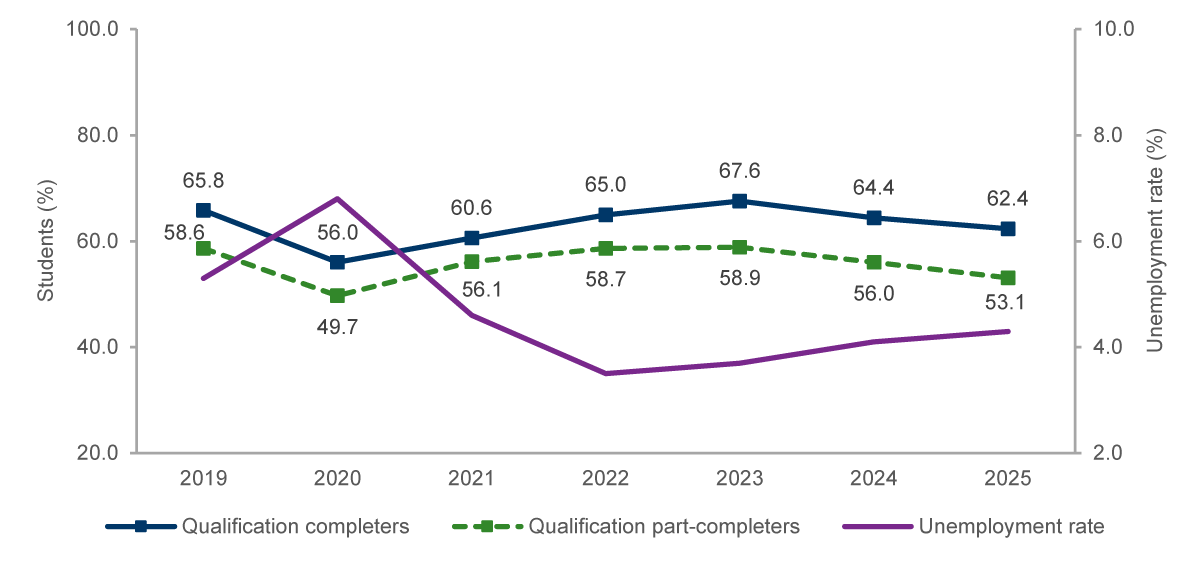
Nearly two thirds (62.4%) of those who completed VET qualifications had an improved employment status after their training, a decrease from 2024. This corresponds with the increase in unemployment (refer Figure 1). Just under a third (32.6%) went on to further study, also down from 2024.
Figure 1 Qualification completers and part-completers with an improved employment status after training and seasonally adjusted unemployment rate, 2019-25 (%)
Source: VET student outcomes 2025; ABS Labour Force, Australia, September 2025 (August data)1
Students completing qualifications from some of the larger training packages had higher rates of improved employment compared to qualification completers overall, including:
- Electrotechnology (76.7%)
- Construction, Plumbing and Service Integrated Framework (73.9%)
- Automotive Industry Retail, Service and Repair (72.6%).
Short training courses meeting students’ needs
The report also explores the outcomes for students who completed smaller components of training, with most short course students (92.1%) and subject(s) only completers (92.6%) achieving their employment-related reasons for training.
‘There has been significant growth in the training market for stand-alone subjects since 2020, with some 3.6 million students undertaking VET subjects in 2024. These are typically focused on occupational health and safety or compliance-related, and are often job requirements. It’s important that these students are having their needs met and achieving meaningful outcomes from their training’, said NCVER Managing Director John King.
Improving completion rates with additional support
The report also gives insights into students who did not complete their qualifications, providing an opportunity for the VET sector to consider additional ways to support their students and increase completion rates.
Over three quarters of qualification part-completers were satisfied with their training (75.4%) and achieved their main reason for training (76.2%).
Personal reasons were most often cited for non-completion (29.5%), with students identifying illness, too many pressures on their time, and family reasons as major barriers to completing their qualifications.
Students who didn’t complete their full qualifications due to training issues (19%) said training was not as expected, timetables were not flexible enough or they had problems with work placement.
‘Our findings show that those who discontinue their training for personal reasons don’t necessarily just cite their 'personal situation’ as the main change needed to encourage completion. It highlights just how multilayered the drivers are for non-completion and for potential re-engagement. We know from previous NCVER research that there are six elements of student support that can help learners on their learning journey, and to complete their training. Combined with a strong focus on student success, they create the conditions for meaningful and effective support’, said Mr King.
Background: The VET student outcomes 2025 report is derived from results of the National Student Outcomes Survey. The survey, collecting information from over 275,000 students between June and August 2025 measures the satisfaction and employment outcomes of students who completed nationally recognised VET delivered by registered training organisations (RTOs) in Australia during the previous year.
Improved employment status is defined as either employment status changing from not employed before training to employed after training or employed at a higher skill level after training or received a job-related benefit. Examples of job-related benefits include got a job or changed job, set up or expanded their own business, got a promotion, gained extra skills for their job, increased earnings or kept current job.
Download the report: VET student outcomes 2025
Enquiries: Elise Stone P: +61 8 8230 8443 E: communications@ncver.edu.au
About NCVER: we are the main provider of research, statistics and data on Australia’s VET sector. Our services help promote better understanding of VET and assist policy makers, practitioners, industry, training providers, and students to make informed decisions. This work has been produced by NCVER on behalf of the Australian Government and state and territory governments, with funding provided through the Australian Government Department of Employment and Workplace Relations.