Description
This publication summarises the outcomes of 11 research projects funded by the National Research and Evaluation Committee. It also contains an introductory chapter by Nigel Smart and an invited chapter from Kaye Schofield. Summaries of each of the 11 research projects are also available in the companion volume - Australian Apprenticeships: Research at a glance.
Summary
Executive summary
INTRODUCTION
by Nigel Smart
Background
It does not seem so long ago that apprenticeships and traineeships were in the doldrums. The number of apprenticeships, after growing during the 1980s, declined during the 1991 recession and only increased again after 1995. There was debate as to whether apprenticeships were relevant in the rapidly changing global economy. Traineeships, after being introduced in 1985 as part of the Kirby reforms, had not been recognised as a viable form of workplace-based training.
That situation has changed dramatically over the last five years. Apprenticeships have been confirmed as a key element of governments' training policies and overall numbers have grown quickly, with numbers in some industries reaching historically high levels. The philosophy behind vocational education and training (VET) delivery has changed radically with the development of the training market and the introduction of 'user choice'. Additional funds were injected into the system by the Commonwealth Government and some State and Territory Governments, and the policy of partnerships involving workplaces and industry in VET has been strongly pursued.
But with all this change and progress, there were some concerns about the development of apprenticeships and whether quality training was being delivered. Research was needed to answer a range of evaluation, policy and knowledge questions, which included questions like:
- what is actually happening in apprenticeships and traineeships?
- are traineeships actually delivering training or are they a form of subsidised employment?
- is the quality of training being improved?
- what is happening to completion? is it important?
- do all the parties understand the direction in which apprenticeships and traineeships are developing?
It was with these and other questions in mind that the National Research and Evaluation Committee (NREC) made apprenticeships and traineeships a key priority for research funding in 1999-2000. As part of a public tender process, organisations and individuals were asked to submit research proposals on the key questions outlined above for consideration, and from these proposals a number of research projects were chosen. In addition, the National Centre for Vocational Education Research (NCVER) contracted a number of specific research projects to complement those from the tender round and provide a more complete view of the situation regarding apprenticeships and traineeships.
This volume brings together all of this research in a form which should be useful to all stakeholders, including policy-makers, providers, employers, and teachers and trainers. It has been produced to assist in converting the research into practical propositions for improvement and development.
In all, 11 research studies are summarised in this volume, and they have been grouped under the following headings:
- Setting the scene
- Factors influencing apprenticeship and traineeship take-up and success
- Evaluation of the training received by apprentices and trainees
- Quality in apprenticeship and traineeship training
This chapter introduces the studies and draws out some of the findings that are of particular interest or in which common themes emerge. The subsequent chapters provide a fuller account of the research, and detailed reports of the research are to be published separately on the NCVER website.
Setting the scene
Two chapters have been written which set the scene for the research:
- 'Apprenticeship in Australia: A concise history' by John Ray
- 'Issues and directions from the Australian apprenticeship and traineeship literature' by Stephen Saunders
John Ray's chapter provides a valuable outline of the development of apprenticeships and traineeships in Australia. It describes a period of gradual improvement and development until the 1970s, punctuated by occasional, more rapid periods of change. The period from the mid-1960s to the mid-1980s saw significant increases in the number of apprentices as new policies and programs were developed and the arrival of skilled immigrants declined.
The chapter makes the point that immediately after the Second World War, training was fast tracked by the Commonwealth Reconstruction and Training Scheme which saw many ex-servicemen being trained as tradespeople in a much shorter time than the then statutory period of five years and without the need for long periods of on-the-job training. The apprenticeship system reasserted itself shortly after this period and once again became the predominant form of trade training, and the opportunity for the development of an alternative form of training was not developed. The chapter by Elizabeth Webster and her team, which is discussed later, suggests that there has more recently been a de facto move in this direction, again with an increasing number of workers in many trades never having commenced an apprenticeship.
From the mid-1970s a number of reviews and studies of apprenticeships and the training system led to increased funding for training, greater Commonwealth involvement and changes in the underlying philosophy of VET. The Kirby Review in 1985 recognised that the training needs of enterprises and the community were changing with the proposed introduction of shorter contracts of training in the form of traineeships. While slow to get off the ground initially, the number of traineeships have surged since the mid-1990s as new areas for training were opened up and growth continues to be strong.
The number of apprentices continued to grow rapidly until 1991, when the recession hit apprenticeship training very hard. Numbers dropped sharply and only recovered from 1995 onwards. Many reforms have been made since that time, most notably New Apprenticeships, and these reforms have been undertaken in the context of much wider reforms to the whole training agenda. In recent years, the number of apprentices has again reached historically high levels.
Ray concludes that the 1990s saw radical changes in the nature of work and that apprenticeships and traineeships will need to continue to change and evolve if they are to remain relevant.
Stephen Saunders in his review of the literature has undertaken the daunting task of developing issues, themes and directions from the great body of literature on apprenticeships and traineeships produced since 1985. This is not the place to further summarise his work, but he has structured his analysis and the development of the associated themes around the following issues and directions:
-
issues:
- supply and demand
- training policy and system
- public training market
- private training investment
- measuring training market outputs
- training intermediaries, pathways and innovations
- training quality and performance
-
directions:
- sharpening training investigation and diagnosis
- repositioning the trades in the training marketplace
- renewing the traineeship consensus
- broadening the horizons for new pathways to vocational skills
- testing new approaches to training markets
- widening the avenues for structured training in enterprises
- using intermediaries to develop new learning pathways
- reinforcing priorities for training measurement and quality
Saunders has done all who have an interest in apprenticeships and traineeships a great service in summarising the extensive literature.
These two chapters provide an excellent introduction to current issues and developments on apprenticeships and traineeships. It will provide valuable reading for both newcomers to the topic and to those already working in policy and strategy development and implementation.
Factors influencing apprenticeship and traineeship take-up and success
Four projects were undertaken to investigate factors influencing apprenticeship and traineeship take-up and success. They are:
- 'Determinants of apprentice training by small and medium-sized enterprises' by Katrina Ball and Brett Freeland
- 'Locational issues in New Apprenticeships' by Tom Dumbrell, Wendy Finnegan and Rowena de Monfort
- 'Unlocking the barriers: A regional perspective of apprenticeships and traineeships' by John Martino and Sue Holden
- 'Apprentices' and trainees' English language and literacy skills in workplace learning and performance: Employer and employee opinion' by Shirley O'Neill and Annabelle Gish
Katrina Ball and Brett Freeland seek to identify the key determinants of apprentice and trainee employment in Australian small and medium-sized enterprises (SMEs). Their study is focussed on SMEs because of the major contribution they make to total employment in Australia.
Their investigation is based on data collected in the Business Longitudinal Survey by the Australian Bureau of Statistics (ABS) over the period 1994-95 to 1997-98. As this survey did not discriminate between apprenticeships and traineeships, the results refer to both forms of training.
Their analysis identifies both training-related and non-training-related characteristics of enterprises which may influence them to take on apprentices and/or trainees. Non-training characteristics include matters such as industry group, employer qualifications, form of the enterprise, union coverage, and size. Training characteristics include participation of existing staff in training, the type of training provided and the training provider used by the enterprise.
The study concludes that there is no evidence of a single business characteristic acting as a trigger for small and medium-sized enterprises to provide apprentice and trainee training, although there are a number of characteristics which affect an enterprise's propensity to undertake apprentice and trainee training. They include:
- size - larger firms with a high proportion of full-time staff are more likely to employ apprentices and trainees
- expansion - firms expanding on existing sites are more likely to employ apprentices and trainees
The most important result of their analysis is the support provided to the concept of a training culture. Their analysis provides evidence of the significant effect of training culture on employers' propensity to provide entry-level training.
Tom Dumbrell, Wendy Finnegan and Rowena de Montfort investigate factors influencing apprenticeship and traineeship take-up from the perspective of the local supply and demand for labour. This study analyses NCVER data on the commencements of apprentices and trainees over the period 1995-96 to 1998-99 by location and compares this with both age 15-24 unemployment and with total unemployment from ABS sources at those same locations.
Dumbrell, Finnegan and de Montfort find that there is no consistent pattern in apprenticeship and traineeship creation on a broad geographical basis, with the ratio of apprenticeship and traineeship commencements to total jobs varying from 1: 29 to 1: 78 in the major metropolitan areas of Australia and from 1: 18 to 1: 50 in non-metropolitan areas. When comparing the ratio of apprenticeship and traineeship commencements to the 15-24-year-old population with the unemployment rate at the same location, they find that there appears to be a correlation between low commencement rates and low unemployment - that is, the lower the unemployment rate the fewer apprentice and trainee commencements.
They then investigated the ratio of apprentice and trainee commencements to total employment within the major metropolitan areas and found widely disparate results, clearly showing that it cannot be concluded that the availability of jobs means that apprenticeship and traineeship openings will also be available. There is a need to look for other factors driving commencement numbers. They also find that across Australia there is generally a geographical mismatch between the location of jobs and the residential location of the young unemployed. It is tempting to conclude that these variations reflect the differing policy approaches being adopted by States and Territories.
Dumbrell, Finnegan and de Montfort suggest that the reason for low participation rates in many areas may be owing to the fact that high growth, high-income enterprises in the knowledge economy are using apprenticeships or traineeships. If so, this phenomenon deserves further investigation.
John Martino and Sue Holden also examine locational issues but focus on one specific area - the western region of Melbourne. The focus of this research is on identifying the barriers to the uptake of apprenticeships and traineeships in this region, especially amongst young people. The findings of the research are based on information obtained from interviews, focus groups and surveys undertaken specifically for the project. The information was obtained from a range of interested parties, including students, teachers, employers, training organisations, organisations co-ordinating the employment of apprentices and trainees and advisers to government agencies.
The key barriers identified by the researchers included:
- school cultures focussed on academic attainment and which view apprenticeships and traineeships as a 'fall back' option
- lack of effective advice to students from schools on career options
- lack of growth in demand amongst employers arising from concerns about potential economic growth
- lack of understanding amongst many employers about apprenticeships and especially New Apprenticeships
- structural and co-ordination issues concerning New Apprenticeships
- the western region of Melbourne being depressed in regard to youth employment outcomes and most apprenticeships tending to be in 'old economy' industries
Shirley O'Neill and Annabelle Gish look at the impact of English language and literacy (ELL) skills of apprentices and trainees on their learning and performance in the workplace once they have commenced. Their research is based on information obtained from surveys of apprentices and trainees and their employers in Queensland and case study interviews in Queensland, New South Wales and Victoria.
This research provides a detailed investigation of the ELL skills of apprentices and trainees and their adequacy, as assessed by both the apprentices and trainees themselves and their employers.
The results of the research show that employers place great emphasis on apprentices and trainees having adequate ELL skills in conjunction with a range of other organisational skills, knowledge of business operations as well as attitudinal qualities they perceive as influencing workplace performance.
Apprentices' and trainees' ELL skills are viewed as having a profound influence on workplace performance as well as learning.
On the surface, the opinion of apprentices and trainees about their own ELL skills was extremely positive compared with that of employers. However, both employers and employees overall identified a need for improvement in the areas of interpreting graphical information, writing legibly, spelling and punctuation and using computers. Both apprentices and trainees acknowledged a need to improve their ELL skills and recognised that these skills were important for their work and continued learning.
In keeping with the trends found in other studies on the importance of generic skills, employers were of the opinion that ELL skill demands were increasing in importance and broadening to incorporate information and technology demands.
Apprentices' and trainees' readiness to accommodate the ELL demands of the workplace also emerged as an important factor, and the extent to which school ELL skills provide a foundation for the demands of the workplace in terms of performance and learning is not clear.
They also found that there is a need to review these skills in the light of the demands of technology and the concept of a knowledge-based economy in the 'new world of work'. Impinging on this issue is the fact that there is considerable variation in the ELL demands of different jobs and different industry areas, yet there is no overarching framework to assist in conceptualising this view.
Besides ELL skill demands varying between jobs and industries, it was found that there may be a mismatch between the ELL skills required on the job and the ELL skills required to learn, particularly for jobs which have low-level literacy demands.
When apprentices and trainees are perceived as lacking adequate ELL skills, this has the potential to have very negative outcomes for all unless it is dealt with in a sensitive manner to avoid stigmatisation. Employers reinforced the view that when employees are unhappy about their ELL skills, they suffer from low self-esteem and lack confidence in doing their work.
These four research projects provide new insights and reinforce our existing knowledge of factors affecting the uptake of apprenticeships and traineeships. It is clear that the issue is complex and not subject to simple solutions. The rapid growth of employment in the 'new economy' at the expense of those industries that have traditionally employed apprentices, the salary benefit of university qualifications, the need for enterprises to be entrepreneurial, flexible and adaptable are amongst the many factors that are outside the direct influence of training policy. The challenge for apprenticeship and traineeship policy-makers is to identify how training can be adapted to this changing environment.
Evaluation of the training received by apprentices and trainees
Four projects were undertaken to evaluate the training received by apprentices and trainees. They are:
- 'The value of on-the-job traineeships' by Josie Misko, Jan Patterson and Rosemary Markotic
- 'Training for skilled trades in Australia, 1980-2000: Training reforms' by Elizabeth Webster, Michael Dockery, Thea Bainger and Ross Kelly
- 'On- and off-job approaches to learning and assessment in apprenticeships and traineeships' by Andrew Strickland, Michele Simons, Roger Harris, Ian Robertson and Maddy Harford
- 'Factors that contribute to retention and completion in apprenticeships and traineeships' by Roger Harris, Michele Simons, Heather Symons and Berwyn Clayton
The first of the studies in this area by Josie Misko, Jan Patterson and Rosemary Markotic investigates the value of on-the-job traineeships. Their chapter forms part of a larger national study that set out to investigate experience in on-the-job traineeships in office administration and small business. The research is based on information obtained from surveys of trainees, registered training organisations' mentors and employers in South Australia.
This research concludes that there are encouraging signs about the ability for on-the-job traineeships to provide relevant and appropriate skills training and experience and job opportunities for trainees.
Amongst the trainees and employers in both industries there was strong support for the value of the on-the-job traineeships in building both work and life skills and for developing increased job opportunities. Large numbers of both trainees and employers (approximately 70% of trainees and approximately 85% of employers) indicated that they would recommend the traineeship to others. The area identified as requiring most need for improvement was assistance during training. It is interesting to note that over half the employers allowed the training to be done during paid time, either during times when work was slow or by setting aside study periods. However, 30% of trainees had real difficulty in finding time to do their studies. Examination of the data suggests that there are potentially two groups of employers with quite different attitudes to the training. In conclusion, the research team identified three areas needing improvement. They are:
- adequate induction strategies for participants
- revisiting policies for consecutive contracts
- broadening the range of training experiences
The project undertaken by Elizabeth Webster and her team was the largest of the studies, being an amalgam of three originally separate studies:
- an examination of the extent to which training-linked career paths have developed in Australia
- job satisfaction in the trades - the relative attractiveness of working in the trades
- attrition from trades
One part of this study, relating to a work experience which was part of the investigation of training-linked career paths, could not be completed in time for this volume and will be reported on separately.
The research reported examines trends in occupational mismatch in the metals, building, vehicle and electrical trades and questions whether the process of award restructuring has created incentives for unqualified blue-collar workers to pursue careers in the trades. It uses data from existing sources together with surveys conducted specifically for the project.
This research has come up with some conclusions that are challenging to the apprenticeship system. These conclusions start by raising the question of whether formal apprenticeship training is needed in the trade areas investigated, claiming that many, if not a majority of, work skills are learned informally on the job.
The analysis finds that in 1996 about one in five trade-qualified workers were employed in lesser skilled occupations and about one in three working tradespeople did not possess trade qualifications. It finds that employers do not appear to value highly many existing trade skills and that workers with a one-year certificate earn, on average, almost as much as fully qualified tradespeople.
It also finds that training pathways for semi-skilled and unskilled adults appear to have become more prevalent since the introduction of award restructuring.
The research by Andrew Strickland and his team focussed on the evaluation of on- and off-the-job approaches to the learning and assessment of apprentices and trainees to identify examples of good practice. It reports, where possible, on apprenticeships and traineeships separately. The study draws on qualitative data from focus groups and case studies involving visits to sites and interviews with human resource managers, supervisors, group training scheme personnel and host employers. It also included a survey of 595 apprentices and trainees in the motor mechanic and hospitality industries.
Strickland et al. identify a range of factors that either support or inhibit successful approaches to learning and assessment. These factors are consistent with, in many cases, findings of other researchers reporting in this volume (for example, the importance of a training culture and the importance of meeting the literacy and numeracy needs of apprentices and trainees) but highlight others, including providing pastoral care, appropriate funding arrangements and apprentice and trainee motivation and quality.
Overall, Strickland et al. find that apprentices and trainees report a high level of satisfaction with their learning and assessment processes which is consistent with other studies (for example, the NCVER graduate outcomes surveys), although apprentices and trainees did identify areas for improvement in workplaces, with the concern at the quality of the on-site trainers and the limited range of work provided at some sites being common. The study itself provides a comprehensive listing. It would seem from the study that apprentices and trainees perceive that although they are satisfied, there remains much that could be done by workplaces to improve their training. The employers no doubt also have their own views about that.
The researchers particularly note that in quite a high proportion of workplaces there are not people selected especially to help apprentices and trainees, which suggests that there is substantial scope still remaining to develop training cultures in workplaces.
They find that apprentices and trainees experience significant differences in treatment in their workplace environments. Trainees indicate that they have clearer formal assessment requirements, are given more feedback and encouragement about their performance and are provided with more opportunities to have their work assessed when they feel ready to talk to employers/trainers about what they would like to learn. Conversely, apprentices appear to have more opportunities while at work to attend classes and workshops that count towards their apprenticeship.
With regard to the off-site learning experiences of apprentices and trainees, the research results reinforce the importance of the contribution that these can make, especially in relation to:
- time to learn and practise skills not taught in the workplace
- time to talk about their job with others
- opportunities to have their competence formally tested
The data also enabled the researchers to compare two training models - a workplace-only model and an integrated model - and found a number of important differences. Interestingly, the aspects in the work environment of apprentices for which there are significant differences between the models are completely different from those of trainees reflecting their different perspectives. The researchers' conclusion regarding workplace-only contracts is one of concern. They find that a significant gap exists between what is perceived as needed in this model and the reality of the training raising issues about the quality of workplace-only training. In this, their findings appear to differ from those of Misko, Patterson and Markotic.
The researchers identify a range of conclusions and only two are identified here:
- there is a great diversity of approaches to learning and assessment practices
- achieving quality learning and assessment systems appears to depend on monitoring the balance of the competing tensions between the needs of the enterprise and the learning needs of the apprentice or trainee, and establishing effective partnerships between the apprentice/trainee, the employer and the training provider
The final study in this category, prepared by Roger Harris and his team, aims to identify and describe the factors that promote the process of retention, including those that are most amenable to change, and to examine possible interventions to enhance retention and increase completions of apprentices and trainees. The report complements that of Strickland et al. referred to earlier.
The project used quantitative data from the NCVER Apprentice and Trainee Statistical collection to develop a macro view of the issues relating to completion and retention. This was followed by 20 case studies covering a range of occupations in five States/Territories. In each State or Territory, two cases of high completions and two of high cancellation/withdrawal were selected. In all, 437 interviews were held.
Any analysis of retention and completion is fraught with difficulty because of definitional, interpretational and reporting issues. For example, many students who do not formally receive a qualification consider that they have successfully completed because their needs have been met. Also, recent studies have shown that many completions are not reported. In these circumstances, care must be exercised in using and interpreting the NCVER data.
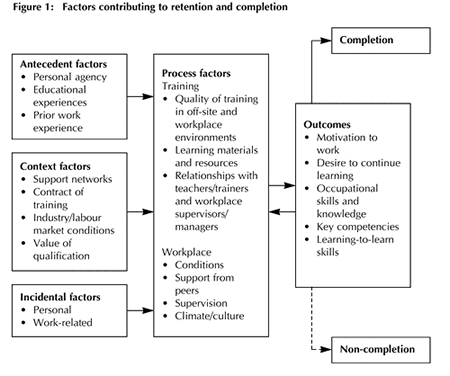
The chapter identifies many factors that influence the process of retention and concludes that it is usually a combination of factors, rather than any single factor, that lead to withdrawal or termination. They also find that the combination is idiosyncratic, so it is not even possible to establish a profile of factors which, when occurring together, indicate high risk. The major factors identified during the qualitative part of the study which impact on retention were found to be:
- a strong sense of personal agency on the part of the individual taking up the contract of training
- a support network (family, partner, friends) for the individual
- an initial placement that is suitable and offers conditions conducive to establishing the necessary support to deal with the demands of the contract of training
- previous satisfying work experience related to the occupational area
- supportive workplace supervisors/managers
- supportive workplace culture
- opportunities to participate in some form of structured training
- reliable transport
- availability of alternative career paths
- value placed on the qualification
Based on their research they have developed a model of the processes affecting retention and this is shown in figure 1 below (see Harris et al. chapter in this report, p.233).
This is a complex interaction. Many of the elements are consistent with research reported elsewhere in this volume. The difficulty is in identifying the right mix and balance of interventions for those individuals at risk of not continuing and who view that outcome as not successful.
Quality in apprenticeship and traineeship training
Kaye Schofield is in a unique position to discuss quality in apprenticeship and traineeship training, having undertaken reviews on this subject in three States - Queensland, Tasmania and most recently Victoria. In her chapter, 'Quality in context: Reflections on factors impacting on the quality of apprenticeship and traineeship training' she draws on her experience from these reviews to explore the more qualitative factors affecting apprenticeship and traineeship training, including workplace culture, personal values and beliefs and working relationships. She refers us to her reports of the reviews for her discussion on training processes and practices and the associated training system architecture.
With regard to apprentices and trainees, Schofield's findings include:
- on-the-job training needs to be structured and planned, the work needs to be relevant, varied and challenging and experienced workmates who can act as mentors and instructors are needed
- off-the-job training must be structured and rigorous, useful and relevant to them in performing their job and have strong links with the on-the-job training
- a quality induction to a firm is critical to a successful apprenticeship or traineeship
While there were differences in the reasons why apprentices and trainees undertook their training and the employment outcomes, their attitudes to what was required for effective training were very similar.
With regard to employers, Schofield's findings seem to point to the need for the employer to:
- take the training seriously
- understand how it needs to deliver effective training
- integrate training into its overall human resource strategy
- have a developed training culture
- see the training as an integral part of its competitive business strategy
- use training to achieve its business objectives
With regard to training providers, Schofield finds that - notwithstanding their operation in a new, volatile and less ordered environment - there appears to be a good deal of provider consensus on what constitutes quality apprenticeships and traineeships, although there are some important differences. The elements where there is consistency included:
- existence of a comprehensive training plan
- extension of experience beyond that provided on the job
- the need for dedicated time off task
- quality staff
The areas of difference included:
- the degree of group interaction necessary to ensure sound outcomes
- the approach to competency, whether specific or holistic
- the importance of workplace training
- their response to the new competitive environment
Schofield concludes with a finding that is supported by a number of the other research studies included in this volume. It is that good vocational learning depends not so much on technical matters as on two less tangible elements - relationships between the apprentice/trainee, the employer and the providers and the organisational cultures within both the workplace and the training provider - both of which are not especially amenable to public policy intervention.
Concluding comments
This introduction has been designed to draw out some of the common themes and the differences that have been found during this extensive research program funded by NREC. It is also designed to whet the reader's appetite so they will proceed on to those studies of particular interest to get the full story.
The issues raised by these studies are considerable as many of the key findings are not readily amenable to policy action by government. Developing strategies to achieve many of the identified ends through co-operation and persuasion is now the key challenge.
Download
| TITLE | FORMAT | SIZE | |
|---|---|---|---|
| Australian-apprenticeships-research-readings-545 | 1.1 MB | Download |