Description
This study examines the geographical distribution of apprenticeship commencements in the context of various labour force and population statistics by industry, location of jobs and youth population. Apprenticeship and traineeship statistics between 1995 and 1998 are examined in terms of occupational groupings, duration, full-time/part-time and qualification levels.
Summary
Executive summary
Introduction
Total apprenticeship [1] commencements in Australia have grown strongly over the last four years, largely through the increase in apprenticeships of less than one year's duration. This increase in commencements has not been evenly distributed across Australia. Tasmania, South Australia, Queensland and Victoria all recorded well-above-average growth, while NSW and Western Australia recorded well-below-average growth.
Focus and methodology of study
The key questions addressed in this study are:
- Do geographical mismatches in the supply of potential apprentices and the demand for them partly explain the co-existence of continuing high levels of youth unemployment and unfilled vacancies for apprentices?
- Do factors other than the labour market explain some of the differences between the States and Territories in the growth rates of New Apprenticeship commencements?
- What policy options exist to overcome any such regional mismatches?
This study examines the geographical distribution of apprenticeship commencements in the context of various labour force and population statistics by industry, location of jobs by industry and youth population. Apprenticeship and traineeship statistics between 1995 and 1998 are examined to demonstrate differences in the development of the system between the States and Territories over recent years. Characteristics of apprenticeships are examined, including occupational groupings, apprenticeship duration, full-time/part-time basis, and Australian Qualifications Framework (AQF) qualification. Interviews were also conducted with officers of State training agencies, group training companies, industry training advisory bodies (ITABs), area consultative committees, industry bodies and some key employers.
Apprenticeship commencements in Australia in 1998-99 were distributed very unevenly on a geographic basis. Using the indicator of apprenticeship commencements to total employment, there are both substantial differences between States and Territories and between smaller geographic units within States and Territories. Reasons for these variations seem to be related to both labour market differences and policy differences. The researchers believe that the regional differences described are substantial and significant in policy terms.
Policy differences appear to have caused some degree of variation in the growth of New Apprenticeships between the States and Territories. As a general observation it appears that New Apprenticeships are achieving a poor market penetration in areas where the labour market, especially for young people, is strong.
One irony, noted by Queensland (DETIR 2000) in its submission to the Senate Committee Inquiry into the Quality of Vocational Education and Training in Australia, is that the apprenticeship system, largely through policy differences, now varies more across the States and Territories than it did before the introduction of New Apprenticeships.
Apprenticeship commencements
This analysis also reveals marked differences in the use of part-time apprenticeships between the States and Territories.
In terms of labour market differences, across Australia in 1998-99 there was on average one apprenticeship commencement for every 38 jobs[2]. Sydney and Perth recorded the lowest ratios of apprenticeship commencements to total jobs. In most of the other main metropolitan areas there was one apprenticeship commencement for about every 30-40 jobs.
Wide variations also occurred within some metropolitan areas. The following table shows the wide range of ratios that exist in selected areas across Australia in the ratio of apprenticeship commencements to total jobs.
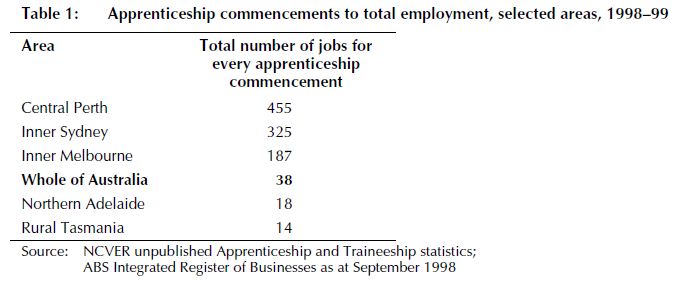
In non-metropolitan areas, commencements to jobs ratios were higher than in metropolitan areas. The non-metropolitan areas of NSW and Western Australia recorded lower commencements to jobs ratios than the other jurisdictions.
At the State/Territory level the findings do not necessarily support the initial proposition that the introduction of New Apprenticeships might favour those regions where jobs are more plentiful. Using another ratio, commencements to 15-24-year-old unemployed, those States with the strongest labour markets in 1998-99, New South Wales and Western Australia, recorded the lowest ratios of commencements to young unemployed. In other words, in stronger labour markets young unemployed people appear less likely to enter an apprenticeship. Conversely, those States with the weakest labour markets for young people, Tasmania and South Australia, recorded strong growth in apprenticeship commencements. Moreover, in New South Wales and Western Australia it appears that a lower proportion of unemployed young people are 'converted' into apprentices. One reason for this might be that in those stronger labour markets, the more marginalised unemployed young people are relatively less likely to have the educational and personal attributes sought by the employers of apprentices.
New Apprenticeships and quality of training
Within metropolitan areas across Australia there was generally a geographical mismatch between the location of jobs and the residential location of the young unemployed. In Sydney the divide is generally an east/west split, while in the other large metropolitan areas the picture is generally one of jobs being concentrated in inner regions and young unemployed in outlying regions. Policies aimed at assisting travel to work within metropolitan areas and in helping young people from non-metropolitan areas to find accommodation in metropolitan areas might assist in filling vacancies for apprentices in metropolitan regions.
There is some evidence that the rapid growth in numbers in some jurisdictions might be associated with a loss in training quality (for example, Schofield 1999a). Several industry contacts cited known examples of poor quality of supervision of training and the exploitation of apprentices. The examples quoted were referred to as traineeships by all the contacts. They offered instances of apprentices being required to work unpaid hours and some, in wholly on-the-job apprenticeships, receiving inadequate instruction.
Moreover, many industry contacts noted that an outdated image of apprenticeships still exists. They believe that inadequate information is provided to young people about the nature of employment as an apprentice. Marshman (1998) found that many employers in manufacturing were unable to recruit apprentices, partly as a result of the poor image the industry has for job stability and working conditions. Marshman advocated specific marketing campaigns directed at the media, teachers, students and individual employers to improve the image of manufacturing and to facilitate their recruitment of apprentices.
New Apprenticeships and employers
While there is some evidence that a lack of quality and a lower income might deter some young people from entering apprenticeships, it is also clear that many employers, including group training companies, believe many applicants for apprenticeship positions lack adequate vocational preparation and a positive attitude to further workplace learning. Research by several Commonwealth agencies (DEWRSB 1998; DEETYA 1998) indicated that only about one in four applicants for apprenticeship positions was judged suitable by the employer.
Outside metropolitan areas few contacts reported difficulties in recruiting apprentices, with some identifying a lack of demand from employers as the main barrier to further expansion of the program. This analysis has identified some specific regions of Australia where there appears to be both an unusually low level of apprenticeship commencements and a relatively high rate of unemployment among the 15-24-year-old age group. These are areas where specific regional initiatives might be targetted towards employers to increase equitable access to apprenticeships on a regional basis.
Five regions across Australia were identified as having both relatively low per capita apprenticeship commencements and an apparently plentiful supply of young unemployed. These areas were Barwon - Western District in Victoria, Richmond - Tweed and Mid-North Coast of NSW, the Hunter region around Newcastle in NSW, the Perth metropolitan area and the Lower Western region in Western Australia. These areas appear prime targets for specific regional initiatives in New Apprenticeships.
Two other regions, Darling Downs/South West Queensland and Illawarra/South Eastern NSW, appear to be regions that, despite having relatively high apprenticeship commencements, also have remaining substantial pools of young unemployed and could also be suitable areas for specific targetting.
Policy options
Given the problems identified in regard to quality (Schofield 1999a), it is not clear that simply aiming to increase apprentice numbers of itself is a desirable aim. It is clear however, that there are geographical regions where apprenticeship opportunities are scarce and there is likely to be a ready supply of suitable applicants.
It is also clear that in some metropolitan regions, especially the CBDs of Sydney and Perth, apprenticeships are only being established in very small numbers relative to total employment in those areas. Of concern is that the businesses found in these areas are more likely to be in the expanding 'new economy' activities of information technology and communications, and other business services. These are sectors where skill shortages are already apparent and are obviously sectors which are likely to offer future prospects. Hence, while there is no industry analysis of apprenticeship commencements undertaken in this study (because of shortcomings in the apprenticeship data collection), it appears likely that industry differences in apprenticeship generation are significant and need to be addressed.
While apprenticeship commencements appear to be more supply-driven than demand-driven, there are parts of the metropolitan areas where young people are much less likely to commence an apprenticeship. These appear to be areas of higher educational attainment and higher socio-economic status and they tend to be areas where labour markets are strongest and 'new economy' industries are emerging.
It seems likely that one factor that militates against apprenticeship commencements in these regions is the popular image associated with the word apprenticeship; that is, one of dirty jobs in often unpleasant working conditions. While this is far from the reality, the image, according to industry contacts, is widely held. Marketing of New Apprenticeships needs to reinforce the message that, in the words of one brochure (Manufacturing Learning Australia, undated) 'the hard labour has been engineered out of modern workplaces' .
Policy-driven initiatives
From this analysis there would appear to be at least three areas where policy initiatives should be considered.
-
Specific regional initiatives in areas where demand for apprentices is particularly low relative to the local youth population and where youth unemployment levels are relatively high: this might involve specific support for group training companies and area consultative committees operating in these regions, relocation and accommodation support for young residents of these areas, or additional financial support for employers. Policy initiatives along these lines could form part of the existing Regional Assistance Program. In 1999-2000 $40.8 million was provided in the Federal Budget under this program which in part is aimed at 'generating employment, creating small business opportunities and building the skills base of regions' (Anderson 1999).
This approach is supported by the Senate committee inquiry into regional employment as quoted by the Queensland Chamber of Commerce and Industry[3]. It noted (p.14) that:Whereas once many businesses had a sense of social or community responsibility to train apprentices, that is now being overshadowed by the national competition policy and increasing pressures to be globally competitive. (QCCI 2000, p.14)
The Committee went on to propose that:
In regions of high unemployment where there are, or will be, skills shortages, priority funding could be given to vocational training to expose young people to occupations in demand and to give them some grounding and experience in those occupations... Such an approach will also be beneficial in encouraging young people to remain in regional localities rather than heading to the city to find employment. The Commonwealth should seek to facilitate these local initiatives wherever possible. (QCCI 2000, p.14)
Given that apprenticeship commencements with government employers have declined more sharply than in other sectors it might be worth considering ways in which governments could, in some instances, act as a direct employer of apprentices in those areas identified as particularly disadvantaged in the provision of apprenticeship opportunities.
-
Initiatives targetted at emerging 'new economy' industries in metropolitan CBDs that do not appear to be involved significantly in the apprenticeship system: for policies to be effective in this area related initiatives would be required both to encourage young people in higher socio-economic areas to enter apprenticeships in these fields and also initiatives to encourage young people from outside these regions to take up ensuing opportunities. Fundamental to the success of this initiative would be complementary promotional programs aimed at dispelling the widespread misconceptions about the nature of apprenticeships and the career options that follow.
Equally important however, would be programs to ensure that quality training is being universally delivered and that apprentices are treated fairly in the workplace. On the other side of the ledger it also seems clear that many young people lack adequate educational preparation for apprenticeships.
-
Marketing initiatives aimed at depicting the nature of working conditions in New Apprenticeships, highlighting the changed nature of the working environment for most New Apprentices: such a campaign would logically be targetted at metropolitan regions where constraints on the supply of potential apprentices are most apparent.
Notes:
[1] Throughout this report the term 'apprenticeships' is used to refer to New Apprenticeships, the apprenticeship system established in 1998 and which covers traditional apprenticeships and what were known as traineeships.
[2] 'Jobs' refers to the total number of persons employed and working within a specific geographical location. Data for this measure are from the ABS Integrated register of businesses.
[3] The citation for this report is Senate Employment, Workplace Relation, Small Business and Education Reference Committee (SEWRSBERC) 1999, Jobs for the regions: A report on the inquiry into regional employment and unemployment, Canberra.
Download
| TITLE | FORMAT | SIZE | |
|---|---|---|---|
| Locational-issues-in-new-apprenticeships-558 | 569.2 KB | Download |