Introduction
This is the DRAFT version of Government funding of VET 2019, not for distribution.
 NCVER
This is the DRAFT version of Government funding of VET 2019, not for distribution.
THIS PUBLICATION HAS BEEN DISCONTINUED AND SUPERSEDED BY APPRENTICE AND TRAINEE OUTCOMES.
For the most recent release please see the Apprentice and trainee outcomes survey page.
This publication provides a time series summary of the outcomes of apprentices and trainees who completed (completers) or cancelled or withdrew (non-completers) from an apprenticeship or traineeship. The figures are derived from the Apprentice and Trainee Experience and Destination Survey. This survey has been conducted in 2008, 2010 and 2019. Information is collected on apprentices’ and trainees’ reasons for training, their employment outcomes, reasons for non-completion, further study outcomes and satisfaction with the apprenticeship or traineeship.
Trades workers
In 2019:
Non-trades workers
In 2019:
THIS PUBLICATION HAS BEEN DISCONTINUED AND SUPERSEDED BY APPRENTICE AND TRAINEE OUTCOMES.
For the most recent release please see the Apprentice and trainee outcomes survey page.
Revised February 2020: Table 17 in Apprentice and trainee experience and destinations 2019 was updated in February 2020. The figures for the number of completer and non-completer respondents remain the same.
This survey collects information on the outcomes of apprentices and trainees who completed (completers) or cancelled or withdrew (non-completers) from an apprenticeship or traineeship during 2018. Information is collected on apprentices’ and trainees’ reasons for training, their employment outcomes, reasons for non-completion, further study outcomes and satisfaction with the apprenticeship or traineeship.
Outcomes
In 2019:
Satisfaction
Main reason for undertaking an apprenticeship or traineeship
The main reason those in a:
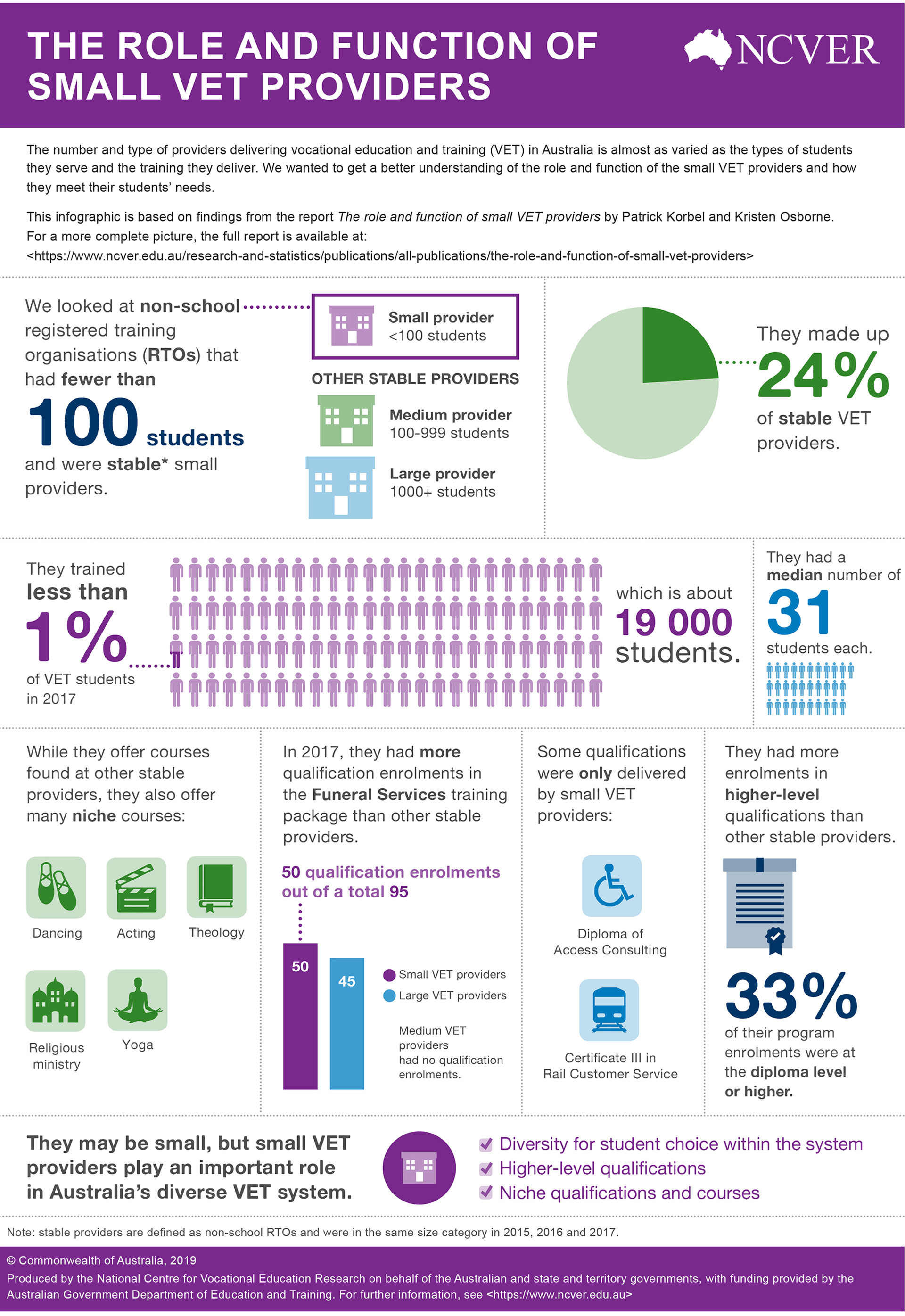
The number and type of providers delivering vocational education and training (VET) in Australia is almost as varied as the types of students they serve and the training they deliver. We wanted to get a better understanding of the role and function of the small VET providers and how they meet their students’ needs.
This infographic is based on findings from the report The role and function of small VET providers by Patrick Korbel and Kristen Osborne. For a more complete picture, see the full report The role and function of small VET providers .
This research explores the views of industry and other stakeholders on the potential broader use of higher apprenticeships. The report highlights some of the complexities that need to be considered and provides examples of where higher apprenticeships and other similar training programs are being developed and trialed in various industries around Australia.
The concept of utilising apprenticeship like models of training at higher qualifications levels to address the evolving skill needs of Australia’s workforce is an emerging issue. Internationally, the application of the apprenticeship model (or similar) at higher vocational education and training (VET) levels, and in higher education, has fuelled discussions on whether these different models could or should be considered in Australia. In addition, the two trials currently being conducted through the ‘Apprenticeship training — alternative delivery pilots’ program, funded by the Australian Government, have further focused attention on the potential for higher apprenticeship models.
Through a national forum of industry reference committee chairs and service skills organisations, and interviews with a variety of stakeholders, this research explores how higher apprenticeships might be conceptualised in different industries and education sectors, the extent of their role and demand, possible structures of higher apprenticeships and the potential challenges to their broader use.
A spectrum of perspectives about higher apprenticeships was uncovered through the research, ranging from those who hold a traditional view of how apprenticeships should continue to be implemented, to those who have a broader perspective on how the model could be modified and expanded.
Key messages
The term ‘higher apprenticeship’ has recently entered the vocational education and training (VET) lexicon in Australia, partly as a result of the ‘Apprenticeships training — alternative delivery pilots’ program, currently underway and funded by the Australian Government. The 2018 National Partnership Agreement on Skilling Australians Fund also refers to ‘higher apprenticeships’.
The Apprenticeships training — alternative delivery pilots are being funded under two streams, with stream two focusing on higher-level apprenticeships, where ‘higher-level’ is defined as diploma or associate degree. The stream two pilots do not elaborate on what is meant by the term ‘apprenticeship’.
In the National Partnership Agreement on Skilling Australians Fund (Australian Government 2018a), a policy definition of higher apprenticeships for the purposes of the agreement is:
Higher apprenticeships combine a program of structured on-the-job training with formal study, with the study component leading to the award of a VET qualification at the Australian Qualifications Framework level 5 (diploma) or level 6 (advanced diploma).
What can be gleaned from these definitions is that the word ‘higher’ in ‘higher apprenticeships’ refers to higher-level qualifications, including higher education qualifications, at the diploma level (AQF 5) and above, and that the term ‘apprenticeship’ can be an arrangement that does not explicitly require a contract of training.
By comparison, there is a long-standing and widely understood definition of an apprenticeship as a contract between an employer and an apprentice (training contract), one that involves a mixture of formal accredited training and on-the-job skills development as part of paid employment. Training contracts are prescribed and registered under states and territories’ legislation. Apprenticeships have traditionally been exclusively confined to a VET qualification.
Note that, for the purposes of this report, the term ‘apprenticeships’ includes both apprenticeships (sometimes referred to as traditional trades) and traineeships when each is undertaken as a contract of training.
As this report indicates, the use of the word ‘apprenticeship’ as a component of the term ‘higher apprenticeship’ has confused some stakeholders. Similarly, the use of the term ‘higher’ to include higher education qualifications is not easily comprehended by those same stakeholders.
Given the above, and to reflect that the term ‘higher apprenticeships’ has been applied in the context of the Australian Government’s alternative delivery pilots and the National Partnership Agreement on Skilling Australians Fund, the term ‘higher apprenticeships’, for the purposes of this report, is defined as:
an integrated program of structured training and paid work, leading to a VET or higher education qualification at the Australian Qualifications Framework level 5 (diploma) or above, which may or may not be undertaken as a contract of training.
The Australian Government’s fact sheet (Australian Government 2015) on the Apprenticeships training — alternative delivery pilots states that they aim to:
These objectives need to be understood in light of the shift towards the attainment of higher-level skills that has been observed in the Australian (and broader global) labour market in recent years and, in parallel, of an expansion of participation in higher education. Technology and work practices are driving demand for people with skills associated with higher-level qualifications, at both the diploma and degree levels.
The Australian Industry Group has recently argued for the need to consider higher apprenticeships, not merely at the diploma and advanced diploma levels, but also in the form of higher education qualifications (Australian Industry Group 2018a). The rationale for this addition included the changing nature of work and the economy, the emergence of Industry 4.0 and the state of the current apprenticeship system.
Implicit in the reference to ‘apprenticeships’ is the view that the fundamental attributes of an apprenticeship, which focus on structured integration of formal training with employment, are desirable and can lead to better outcomes than the more prevalent pathway of individuals gaining a credential through institutional learning and subsequently seeking employment.
Higher apprenticeships are also gathering momentum in international training systems and labour markets. Significant reforms in the United Kingdom demonstrate the potential of different (alternative) higher apprenticeship models, with graduates being rated as more employable and having high completion and better staff-retention rates, as well as providing a strong return on investment for government.
The participants in this research identified several broad roles that different higher apprenticeship models could fulfil:
The participants were also able to suggest specific industries where higher apprenticeships could have a role, in particular, industries with high technical skill requirements, especially those occupations which require a combination of mechanical and computer-based skills, such as in advanced manufacturing. Other potential roles identified included those jobs where practical experience is just as valuable as knowledge-based skills, such as in human services, health and other para-professional occupations.
In some instances, higher apprenticeships were being considered primarily as an alternative recruitment strategy. Developed under the Apprenticeships training — alternative delivery pilot, the PricewaterhouseCoopers (PwC) Higher Apprenticeships and Traineeships Pilot, for example, is designed as an alternative pathway to the traditional graduate program.
Not all of the participants were able to identify what they thought the potential purpose of higher apprenticeships would be. This was particularly difficult for those who were unfamiliar with the concept of higher apprenticeships and those who could not conceptualise the application of higher apprenticeships in their particular industry.
The stakeholder consultations revealed that, for those coming from a VET sector perspective, there was broad agreement that the key elements of higher apprenticeships should retain the same features as traditional apprenticeships, but a higher level of training would be expected.
Interviewees who were more aligned with the higher education sector however tended to focus on the broader notion of integrated training and employment when asked about what they saw as the key elements of higher apprenticeships. Developing skills in a work context was seen as important.
As the report indicates, assessment of the opportunities and barriers to higher apprenticeships is heavily influenced by what stakeholders conceptualise or prefer as a model for a higher apprenticeship, specifically, whether a contract of training is involved.
For those who conceive of a higher apprenticeship model without a contract of training, there are arguably no administrative or regulatory barriers to establishing an integrated training and employment higher apprenticeship program, other than a lack of awareness of what is possible (opportunity) and uncertainty regarding how to set it up.
For those who prefer the more traditional model, one that involves a contract of training, there are more challenges, especially for higher education programs. The process for establishing an apprenticeship (where one doesn’t already exist) and navigating the intersection between state-based apprenticeship regulations and the industrial relations system, where applicable, can be daunting. The two pilot programs funded under the Australian Government’s Apprenticeships training — alternative delivery pilots program, as well as other local initiatives being implemented across the country, provide some useful insights into these issues.
In terms of assessing the demand for higher apprenticeships, it is again necessary to distinguish between demand for higher apprenticeships under a contract of training and demand for alternative training and employment pathways at higher qualification levels.
For higher apprenticeships under a contract of training, it needs to be acknowledged that many VET diploma and advanced diploma apprenticeships already exist in a range of industry areas.
A recent review of the published lists of registered/declared apprenticeships at the diploma and advanced diploma levels in each state and territory revealed that, nationally, 302 qualifications across around 50 training packages are currently available, ranging from 27 qualifications in South Australia, to 231 qualifications in the Northern Territory.
Of the 302 qualifications nationally, 259 qualifications (85%) had no apprenticeship commencements in 2017. Of the 3801 commencements in diploma and advanced diploma apprenticeships in 2017, the Diploma of Leadership and Management and the Diploma of Early Childhood Education and Care collectively accounted for three-quarters of all commencements.
While some caution needs to be exercised in interpreting these data, since the state and territory lists were not validated and not all qualifications are available as apprenticeship pathways in every jurisdiction, the indications are that, despite the wide range and spread of available qualifications, there is very little demand outside these two qualifications.
By contrast, in 2017 there were 378 128 domestic enrolments in VET diploma and advanced diploma qualifications and a further 36 520 enrolments in higher education diploma and advanced diploma qualifications and 6631 enrolments in higher education associate degrees that were not under a contract of training. These data are however unable to reveal how many of these enrolments were ‘sponsored’ by firms as part of an integrated training and employment program.
What this perhaps suggests is that the overall potential level of demand for higher apprenticeships outside a contract of training is significant should firms wish to embrace models of higher apprenticeships, as outlined in this report.
Research messages brings together publicly released research produced by NCVER each year. This year’s compilation includes an extensive array of research activities undertaken during 2018, comprising of research reports, summaries, opinion pieces, infographics, interactive tools, presentations, in-house seminars, submissions, webinars, the 27th National Vocational Education and Training Research Conference ‘No Frills’, VOCEDplus knowledge resources curation, and the National VET Data Linkage Roundtable.
Presented here is a summary of statistics relating to young people aged 15 to 19 years who participated in education and training with an Australian provider during the year. Information on participation is presented for school students, higher education students, apprentices and trainees, and vocational education and training (VET) students.
This publication presents a summary of statistics relating to young people aged 15 to 19 years who participated in education and training with an Australian provider in 2017. It brings together data from multiple sources.
A snapshot as at August 2017 shows there were 1.5 million Australians aged 15 to 19 years, of which an estimated 82.8% participated in education and training. An estimated:
During the 2017 calendar year, among all students aged 15 to 19 years who participated in education and training with an Australian provider, there were an estimated:
Research messages brings together research publicly released by NCVER over the year. The 2017 compilation reflects an extensive collection of NCVER research activities undertaken during 2017, comprising of reports, summaries, infographics, occasional papers, presentations and webinars.
This good practice guide explores the types of social media being used in vocational education and training (VET) courses, the benefits and pitfalls of using social media in teaching and learning as well as tips for incorporating social media into VET courses. This guide is based on the report 'Social media and student outcomes: teacher, student and employer views' by Victor J Callan and Margaret A Johnston.